What progression means in Fake a Player
Fake a Player progression is a repeatable round-to-round path rather than a confirmed level-up tree. Your practical goal is to enter a round, improve your chase or escape decisions, finish with a result you can inspect, and use that feedback in the next round. The available game description emphasizes fakes, quick moves, and sharp dodges, while the progression record connects repeated rounds with Cash, MVP recognition, leaderboard results, and longer-term Crew competition.
There is no reliable confirmation of permanent character levels, a complete upgrade tree, or a confirmed spending shop. Treat Cash as a reward or currency signal, not as proof of a specific purchase system. Likewise, MVP is a round-performance label, not automatically the same thing as first place or a permanent rank.
For a first session, use a simple target: complete a round, identify whether your movement created or stopped a chase advantage, and check the end-of-round feedback before leaving. Once you can explain what changed between two rounds, you can pursue higher placement, MVP, a streak-related target, or Crew competition without confusing an unconfirmed statistic for a guaranteed progression track.
How a round feeds the next result
The supported structure is session-based and cyclical: you play a round, produce a chase or escape result, receive whatever feedback the current interface shows, and make a better decision in a later round. It is not a confirmed linear campaign with numbered stages. Each round is a fresh opportunity to test movement and role decisions, while the cumulative goals—Cash, better placements, MVP mentions, streak targets, and Crew results—give repeated play a longer horizon.
At the start, read the active role and the round context. The progression information covers Survivor evasion, Juking, and pursuit by an Infector or Slasher. Your immediate objective changes with that relationship: an escaping player wants to preserve options and break a readable line; a pursuer wants to close space and force a predictable turn. Do not assume one universal score formula applies to both sides.
During the round, movement creates the useful progression signal. A successful dodge, a stopped chase, a conversion, an attack, or simply surviving long enough to reach the end can change what you learn from the session. Players discuss money, cash, or bucks, and a sickness choice has been described as providing a 10% cash increase, but the complete reward formula is not established. Use the current result panel rather than calculating a guaranteed payout.
After the round, inspect the result promptly. MVP and leaderboard feedback may appear at the end, and one report says a third-place result was difficult to inspect because the leaderboard disappeared. If the panel is visible, note your placement and any Cash or MVP result before moving on. If it vanishes, record only what you actually saw; do not fill in missing totals from a community claim.
Cash, MVP, ranks, and Crew goals
Use the following progression elements as separate signals. They overlap in a session, but the available rules do not prove that one automatically unlocks another.
| Progression element | What it tells you | Beginner use |
|---|---|---|
| Cash | A round-related reward or currency signal | Check the current result panel; do not assume a payout formula or shop item |
| MVP | Recognition for standout performance in one round | Review what movement or chase decision produced the strongest result |
| Leaderboard | A temporary comparison of round performance | Read placement at round end before the display disappears |
| Streak / Top 10 | A reported long-term performance target | Treat 20-streak, 18-streak, and Top 10 as targets until the panel defines them |
| Crew | A team-based competition layer | Use it for group goals only when the current Crew interface explains the rules |
| Spectating | A way to study surviving players after elimination | Watch routes, turns, loops, and jukes to choose one adjustment next round |
Cash is the most easily misunderstood element. The records mention money, cash, and bucks in gameplay discussion, but do not establish whether those words are one field or separate rewards. A sickness choice is also described as a 10% cash increase; treat that as a reported choice effect, not as a universal multiplier for every activity. Before planning purchases, confirm the wording and total in the live interface.
Check the sickness choice's Cash effect
This moment supports the reported 10% Cash increase tied to a sickness choice while the article cautions against treating it as a universal multiplier.

MVP is more useful as a performance review than as a rank. A player was identified as MVP after repeated juking and strong play, so movement quality can matter in recognition. That does not prove the exact scoring weights, whether the title is saved, or whether MVP always means the round winner. Ask what you did well, then reproduce that decision rather than chasing the label alone.
Leaderboard placement is a snapshot. Third place has been reported, but the display may not remain available long enough to inspect. Streak and Top 10 references are also incomplete: 20-streak and 18-streak are mentioned, but their exact statistic and threshold behavior are not confirmed. Crew-versus-Crew competition is discussed as a group objective, yet creation requirements, member limits, scoring, rewards, and reset timing are not established.
Review streak and Crew progression goals
These moments support the article's reported Top 10 and streak targets alongside Crew-versus-Crew competition, without treating their rules as confirmed.
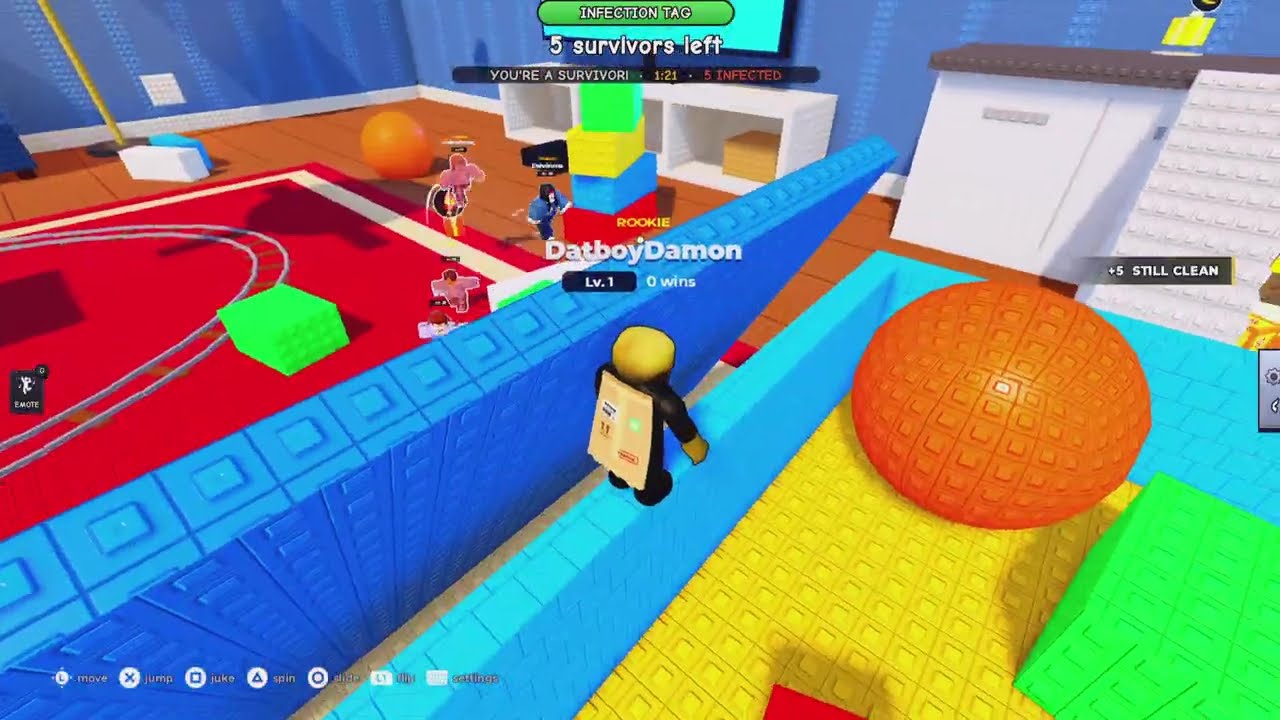
Your first progression-focused round
- Read the round context. Confirm your current role and whether the round presents an Infection Tag or Slasher-style chase relationship. The game modes guide explains the role context that determines whether you should prioritize escaping, pursuing, or observing the relevant threat. Move only after you know which player or route matters.
- Choose an exit before contact. As a Survivor, keep a second direction available instead of running into a corner or wall gap with no reversal. As a pursuer, approach from an angle that limits the opponent's next turn. The checkpoint is a route you can still change; transition when the first line becomes readable.
- Make one deliberate movement change. Use a quick turn, obstacle, crouch, loop change, or other sharp dodge supported by the game's movement style. Do not repeat the same turn until the opponent can anticipate it. A successful change should create distance, break the chase line, or force the opponent to redirect.
- Reassess after the chase state changes. A tag, conversion, attack, elimination, or new threat changes the useful route. In Infection Tag, a converted player increases pressure on remaining Survivors. In Slasher, an attack or elimination removes an active player and can lead to Spectating. Transition when the original threat is no longer the only threat.
- Preserve the lesson, not just the outcome. If the move worked, identify the timing and the opponent's commitment that made it work. If it failed, identify whether the problem was a predictable line, a trapped corner, or a late turn. This checkpoint gives the next round a specific experiment instead of a vague goal to “play better.”
- Finish the round and check the result panel. At the end, look for Cash, MVP, placement, or leaderboard information while it is visible. Record only confirmed values from the panel. If the leaderboard disappears, keep the observed placement separate from any unverified explanation of why it disappeared.
- Set one next-round target. Choose one supported objective: create a safer exit, earn stronger performance feedback, improve placement, or study a surviving player's route while spectating. Do not combine an unconfirmed 18-streak or 20-streak rule with a guaranteed reward claim. Start the next round only after you can state what decision you will change.
Priorities and recovery after mistakes
Prioritize survival or chase control before reward speculation. Cash and MVP are useful feedback, but neither replaces a safe route decision. Keep an exit open, vary your movement before it becomes readable, and reassess whenever the round's active threat changes. Then inspect the result panel quickly, because temporary feedback is more useful than an assumed total.
- You repeat one loop and get read. Change direction earlier on the next attempt and use an obstacle or reversal rather than returning to the same turn. If the round has already turned against you, spectate the remaining player and study when they change routes.
- You enter a corner without an exit. Stop treating the corner as a guaranteed dodge. In the next chase, preserve room to reverse before contact; if you are already eliminated, use Spectating to identify a route with a second line.
- You are tagged or eliminated early. Treat the state change as information, not as proof that progression stopped. In Infection Tag, note how the new Infected pressure changes safe space; in Slasher, watch the active player's turns and carry one route adjustment into the next round.
- You miss the leaderboard or MVP display. Do not reconstruct a placement or reward from memory or a reported formula. Record what was visible, then use the next round's panel as the authoritative check for current feedback.
- Cash does not match your expectation. Recheck the current result wording and any active choice, including the reported sickness choice that may show a 10% cash increase. Do not assume money, cash, and bucks are identical fields or infer an unlisted purchase price.
- Crew progress is unclear. Wait for the current Crew interface to identify its contribution and ranking rules. Until then, coordinate around the round decisions your group can observe—survival, chase pressure, and route quality—without promising a specific team reward or reset schedule.
The durable progression habit is simple: play a complete session, inspect the feedback while it exists, and convert one observed mistake into one changed decision. That approach supports Cash, MVP, placement, streak, or Crew goals without inventing a level system the current game information does not confirm.
First-time Fake a Player progression questions
Is there a confirmed level-up system in Fake a Player?
No confirmed level or upgrade tree is established by the available progression information. Treat repeated rounds, Cash, MVP, placements, streak-related targets, and Crew competition as separate progression signals until the current game interface shows a formal level system.
Does MVP mean I won the round?
Not necessarily. MVP is described as recognition for standout round performance, including strong juking, but the exact scoring and relationship to winning are not confirmed. Check the round result panel for the separate placement or outcome.
What should I do if the leaderboard disappears?
Use any placement you personally saw, but do not infer missing details from an unverified formula. Check future round-end panels promptly, since leaderboard visibility may be temporary.
Are the 18-streak and 20-streak targets fully explained?
No. They are reported as long-term targets alongside Top 10, but the available information does not establish whether they measure wins, survival, eliminations, or another statistic. Follow the current in-game panel for the active definition.
Are Crew rewards and contribution rules confirmed?
No. Crew-versus-Crew competition is discussed, but creation requirements, member limits, contribution scoring, rewards, and ranking periods are not confirmed. Use the live Crew interface before promising a team outcome.